

Design & build · Provisional page
Turn a valuable use case into data people can work with.
A useful idea for an application, an AI service or better decision-making can stall when the underlying data is difficult to understand or change. Different teams interpret it differently. Integrations multiply, and a new question seems to require another round of data preparation. Customers want to see the idea work while keeping room to adapt.
Connect domain knowledge to a working result.
We start with the people who understand the domain and those who will use the result. Together, we shape data products with a clear purpose, ownership and conditions of use. InformationGrid provides model-driven technology to express domain meaning and events, preserve history and support change as understanding develops.
API-first integration makes those products available to applications and analytics, including tools such as Power BI. For AI, we focus on the meaning, provenance and permitted use of the data that informs the solution. Where collaboration crosses organisational boundaries, a dataspace provides the governance context for making data available under agreed conditions.
As part of Yuma, we connect this work to the wider ambition of AI transformation: making data, organisational capability and responsible use develop together.
Useful increments, shaped by feedback.
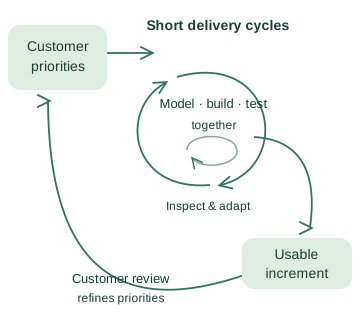
We prioritise customer needs together and agree on a small, useful outcome for the next short cycle. Domain modelling, design, development and testing happen within each iteration, producing an increment people can actually use rather than a handover to another phase.
Users and domain experts review the result with the team. Their experience reshapes the priorities, while the team regularly inspects and adapts its own way of working. These connected feedback loops allow the solution and our understanding of the challenge to evolve together.
Working methods that fit your situation.
Domain modelling sessions can bring domain experts and developers around shared language, events and rules. Collaborative prototyping makes design choices tangible. Short development cycles then produce a small end-to-end increment, reviewed with users and governance specialists. Integration experiments or data-product reviews can resolve specific uncertainties along the way.
What the work makes possible
A next step you can build on.
The intended result is a working capability that addresses the chosen use case and can be extended. That may be a governed data product, an API, an analytics integration or a source of reliable context for AI. Supporting models, ownership decisions and validation evidence help your team understand what has been built, operate it responsibly and choose the next improvement.
Explore InformationGrid and Agile Data →Start a conversation